Source 360 degree rotating garden sprinkler for Farms, Lawns, and Gardens
Explore 30 listings of 360 degree rotating garden sprinkler options with varying pressure, flux, and spray radius. Compare oscillating and gear drive models from Zhejiang and Shandong manufacturers to find the right irrigation solution for your needs.
Key considerations
Products List




Comprehensive Sourcing Guide
Strategic Sourcing Guide for 360-Degree Rotating Garden Sprinklers
Understanding the Technical Landscape of Rotating Sprinklers
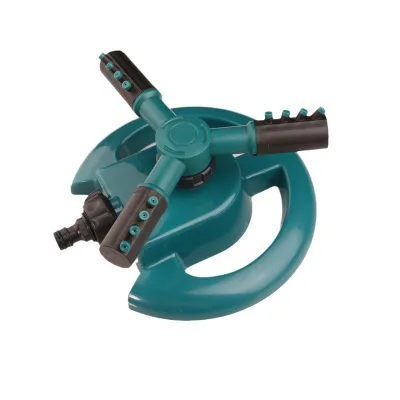
The core keyword "360-degree rotating garden sprinkler" encompasses a diverse range of irrigation devices designed to distribute water uniformly across agricultural and residential landscapes. Based on the observed product attributes, these units are primarily categorized by their drive mechanisms and operational pressures. The market features distinct variations, including the "360 Gear Drive" type and "Oscillating" models, each serving specific hydrological needs. The gear drive mechanism is particularly noted for its ability to provide consistent, full-circle coverage, which is essential for large-scale agricultural irrigation where uniformity is critical. In contrast, oscillating models often serve different application profiles, potentially offering variable coverage patterns.
A critical technical differentiator among these units is the operating pressure range. The supplied data indicates that specific models operate within a pressure range of 1.5 to 3.0 Bar, while others are designed for higher performance, functioning between 2.0 and 3.0 Bar or even 2.0 to 4.0 Bar. Some high-capacity units are rated for pressures up to 5 Bar. These pressure specifications directly influence the spray radius and water flux. For instance, lower pressure units may achieve a spray radius of 1 to 3.5 meters with a flux of 40 to 200 liters per hour, whereas high-performance models can extend the spray radius to 2.8 to 4.5 meters or even 9 to 20 meters, with water fluxes reaching up to 6000 liters per hour. Buyers must align these technical specifications with their specific water supply infrastructure to ensure optimal performance without risking equipment failure due to over-pressurization or under-performance.
Material Composition and Durability Factors
The longevity and suitability of a 360-degree rotating sprinkler are heavily dependent on the materials used in its construction. The product data reveals a bifurcation in material choices, with some units constructed from "Plastic" and others from "Metal." Plastic models, often associated with specific model numbers like 1112 or 1108, are generally lighter and cost-effective, making them suitable for residential or light-duty agricultural applications. These units typically have a weight range of 5 to 8 kg, which facilitates easier installation and transport.
Conversely, metal construction is indicated for more robust applications, potentially offering enhanced resistance to UV degradation, physical impact, and extreme weather conditions. The choice between plastic and metal should be evaluated against the environmental conditions of the intended site. For example, in areas with high UV exposure or where the sprinkler is subject to frequent physical contact, metal components may provide a longer service life. Additionally, the internal components, such as the gear drive mechanism, must be compatible with the selected housing material to prevent corrosion or mechanical binding. Buyers should verify the specific material grade used in the manufacturing process, as "Plastic" can range from low-grade polymers to high-density engineering plastics, significantly affecting durability.
Performance Metrics and Operational Specifications
When evaluating the performance of 360-degree rotating sprinklers, three primary metrics demand attention: spray radius, water flux, and working pressure. The observed data highlights a wide spectrum of capabilities. For smaller scale applications, the spray radius ranges from 1 to 3.5 meters, with a water flux of 40 to 200 liters per hour. This configuration is ideal for small garden plots or localized irrigation needs. However, for larger agricultural fields, the specifications shift dramatically. High-capacity models exhibit a spray radius of 9 to 20 meters or even 19 to 25 meters, with water fluxes ranging from 3000 to 6000 liters per hour.
The working pressure is a governing factor for these performance metrics. Models are designed to operate within specific pressure bands, such as 2.0 to 4.0 Bar or 2 to 5 Bar. It is imperative for buyers to ensure that their water supply system can maintain the required pressure to achieve the advertised spray radius. If the supply pressure falls below the minimum threshold, the sprinkler may fail to rotate or provide insufficient coverage. Conversely, exceeding the maximum pressure rating can lead to seal failure or structural damage. The water flux, measured in liters per hour or cubic meters per hour (10-35 M3/H for high-capacity units), must be calculated based on the total area to be irrigated and the desired watering frequency.
Packaging, Logistics, and Origin Considerations
Logistical planning for 360-degree rotating sprinklers requires careful attention to packaging standards and product origin. The data indicates that products originate primarily from Zhejiang and Shandong provinces in China. This regional concentration suggests a mature supply chain with established manufacturing capabilities. The packaging methods vary, with options including "Poly Bag," "Color Box," "Standard Export Carton Box," and simple "Carton" or "Box" packaging. The choice of packaging impacts the unit's protection during transit and its presentation to the end-user.
Standard export carton boxes are often preferred for bulk orders to ensure maximum protection against moisture and physical damage during shipping. Specific packaging dimensions are also noted, such as 423430 cm, which is crucial for calculating shipping volume and container load optimization. The gross weight (Gw) of a carton is recorded at 12.5 kg, and the quantity per carton can be as high as 3000 units for certain models, indicating highly efficient packing for smaller components. Buyers must verify the specific packing details for their selected model to accurately estimate freight costs and storage requirements. Furthermore, the product standard is listed as "Standard" or "custom," and dimensions like 20 × 18 × 9 cm are provided for specific packaging configurations. Understanding these logistical parameters is essential for maintaining cost efficiency and ensuring the products arrive in pristine condition.
Cost Drivers and Procurement Economics
The cost of 360-degree rotating garden sprinklers is influenced by several variables, including material composition, performance specifications, and customization options. The observed price range in the market spans from $0.04 to $120, reflecting the vast difference between basic plastic units and high-end metal or high-capacity models. The Minimum Order Quantity (MOQ) also varies significantly, ranging from 10 to 5000 units. This wide MOQ range offers flexibility for buyers of all sizes, from small retailers to large agricultural contractors.
Customization is a key factor that can drive up costs. The data confirms that customization is available, which may include branding, specific color schemes, or tailored packaging. While customization adds value, it typically increases the unit price and may extend lead times. Buyers should weigh the benefits of custom branding against the cost implications, especially for smaller order volumes. Additionally, the model number often correlates with performance and price; for example, models like 3148 or 1201 may have distinct pricing structures compared to standard models like 1102. Understanding the correlation between model specifications and price is vital for budgeting and selecting the most cost-effective solution for the intended application.
Supplier Evaluation and Quality Assurance Protocols
Selecting a reliable supplier for 360-degree rotating sprinklers requires a rigorous evaluation process focused on quality assurance and compliance. Given the diverse range of materials and specifications, buyers must verify that the supplier can consistently meet the required technical standards. The presence of specific model numbers like 1112, 1108, and 3435 suggests a standardized production line, but buyers should confirm that these models meet the specific pressure and flux requirements for their projects.
Quality control should encompass material testing, particularly for metal components to ensure resistance to corrosion and plastic components to verify UV stability. The working pressure ratings must be validated through testing to ensure they align with the advertised specifications. Buyers should request test reports or certification documents that confirm the product's ability to withstand the specified pressure ranges without failure. Additionally, the origin of the product, whether from Zhejiang or Shandong, should be verified to ensure it matches the supplier's claims. A reputable supplier will provide transparent information regarding their manufacturing processes, quality control measures, and compliance with relevant industry standards.
Long-Term Procurement and Application Strategy
For long-term procurement, buyers should consider the total cost of ownership, which includes not only the initial purchase price but also maintenance, replacement parts, and operational efficiency. The 360-degree rotating sprinkler is a critical component in agriculture irrigation, and its reliability directly impacts crop yield and water conservation. Selecting a model with the appropriate spray radius and flux for the specific terrain and crop type is essential for maximizing efficiency.
Buyers should also consider the scalability of their procurement strategy. With MOQs ranging from 10 to 5000, suppliers can accommodate both pilot projects and large-scale deployments. However, buyers must ensure that the supplier has the capacity to maintain consistent quality and delivery schedules as order volumes increase. The availability of customization options allows for brand alignment, but buyers should plan these requests well in advance to avoid delays. Finally, establishing a long-term relationship with a supplier who understands the specific technical requirements of 360-degree rotating sprinklers can lead to better pricing, priority support, and access to new product innovations.
Comparative Analysis of Sprinkler Specifications
To assist in the decision-making process, the following table summarizes the key technical specifications observed in the market for 360-degree rotating garden sprinklers. This comparison highlights the variance in performance capabilities and helps buyers identify the most suitable model for their specific needs.
| Feature | Low-Capacity / Residential | Mid-Range / General Agriculture | High-Capacity / Large Scale |
|---|---|---|---|
| Sprinkler Type | Oscillating / Gear Drive | 360 Gear Drive | 360 Gear Drive |
| Material | Plastic | Plastic / Metal | Metal |
| Working Pressure | 1.5-3.0 Bar | 2.0-3.0 Bar | 2.0-5.0 Bar |
| Spray Radius | 1-3.5 M | 2.8-4.5 M | 9-25 M |
| Water Flux | 40-200 L/H | 32-115 L/H | 3000-6000 L/H |
| Typical Model No. | 1112, 1108 | 1102, 3435 | 3148, 1201 |
| Weight | Light (Plastic) | Medium | 5-8 kg (Metal) |
| Origin | Zhejiang, China | Zhejiang, China | Shandong, China |
This table underscores the importance of matching the sprinkler's technical specifications to the project requirements. While low-capacity models are suitable for small gardens, high-capacity units are necessary for extensive agricultural operations. Buyers should carefully review these parameters to ensure the selected sprinkler delivers the required coverage and efficiency.
FAQs
What materials are used for 360 degree rotating garden sprinklers?
These sprinklers are constructed from either plastic or metal. Plastic models like 1112 are lighter and cost-effective, while metal versions offer enhanced durability for harsh conditions.
How does the pressure rating affect the spray radius?
Operating pressure directly determines the spray radius and water flux. Units rated 1.5-3.0 Bar typically reach 1-3.5 meters, whereas higher pressure models up to 5 Bar can extend coverage to 25 meters.
Which models support customization options for branding?
Customization is available for various models including 1108 and 1201. Buyers can request tailored packaging or specific features, though this may impact unit pricing and lead times depending on order volume.
Can I find suppliers in Zhejiang or Shandong for these units?
Yes, products originate primarily from Zhejiang and Shandong provinces in China. These regions host established manufacturing chains capable of producing both plastic and metal variants for export.
What is the typical water flux range for high-capacity models?
High-capacity models can handle water fluxes ranging from 3000 to 6000 liters per hour. Lower capacity units typically operate between 32 and 200 liters per hour depending on the specific model.
How do packaging standards vary for export orders?
Packaging options include Poly Bags, Color Boxes, and Standard Export Carton Boxes. Specific dimensions like 42*34*30 cm are used for certain models to optimize shipping volume and protection.
What is the minimum order quantity for these sprinklers?
The minimum order quantity ranges from 10 to 5000 units depending on the supplier and model. This flexibility allows buyers to select quantities suitable for both small retail and large agricultural projects.